
How Do You Become a Medical Courier Independent Contractor?
Quick answer
You need a clean driving record, a reliable car, HIPAA and bloodborne pathogens training, a tax ID or registered business, and insurance that covers driving for pay. Then you sign 1099 agreements with courier companies or contract directly with labs and pharmacies. On CouriGigs, 449 of the 975 medical courier listings open in November 2026 (46%) were contractor roles, and 891 of them needed only a regular car.
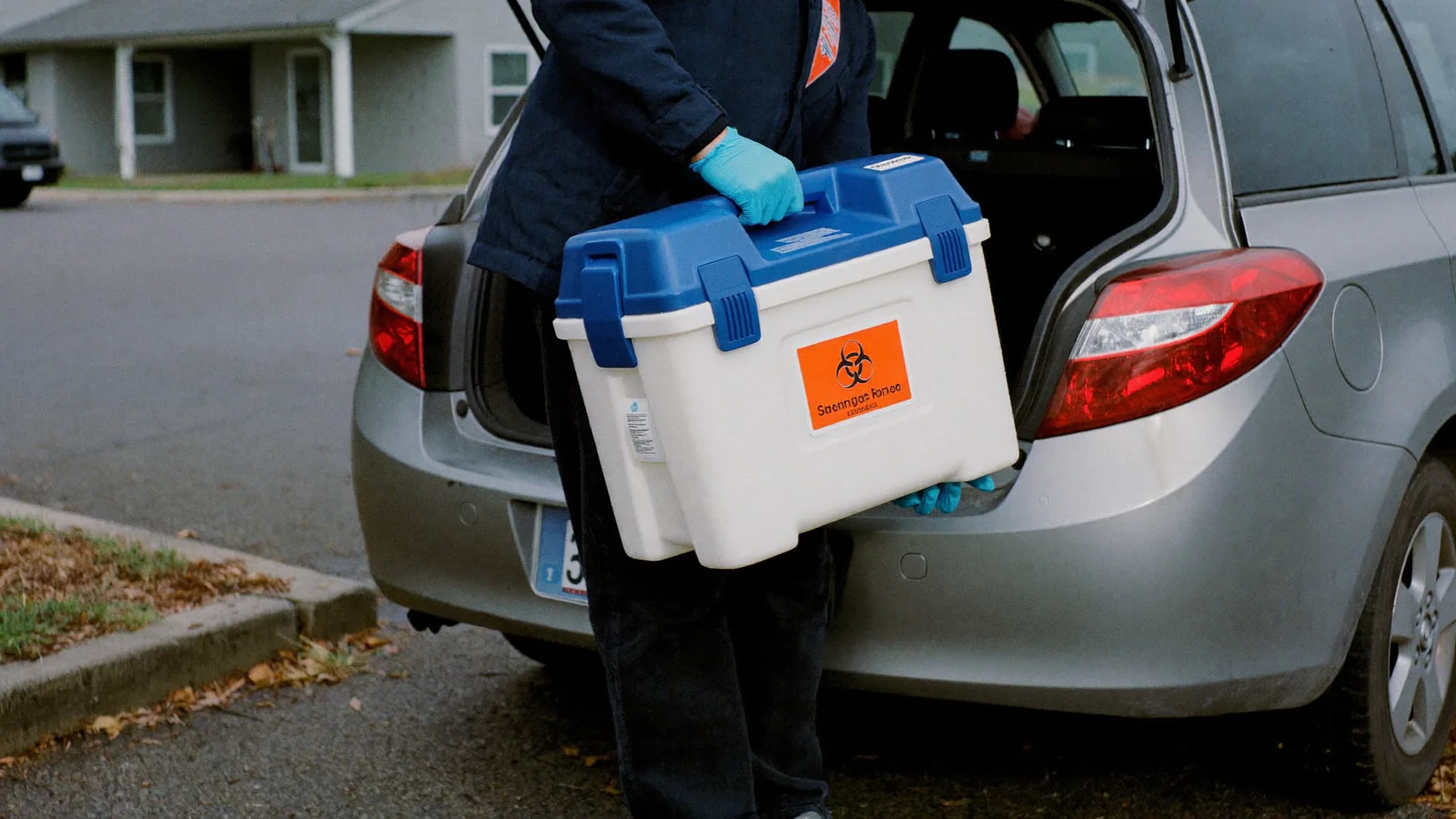
A medical courier independent contractor moves lab specimens, prescriptions and medical supplies for labs, pharmacies, clinics and hospitals, but runs as a one-person business. Nobody assigns your shifts or pays for your gas. You pick the contracts, carry your own insurance, and keep what's left after costs and taxes.
For plenty of drivers that trade is worth it. Most guides on this topic list the same requirements and stop there. This one also covers what clients check before they hand you a cooler, what the money looks like once miles and self-employment tax come out, and where contractor work actually gets posted. The numbers come from the 975 medical courier listings live on CouriGigs in November 2026, plus the IRS, HHS, OSHA and Bureau of Labor Statistics sources linked along the way.
What independent medical couriers actually do
Most of the work falls into four kinds of runs, and a full day usually mixes two or three of them.
- Scheduled lab routes. You loop through doctors' offices, urgent care clinics and draw sites, collect the day's specimens, and get them to a lab before its processing cutoff. Miss the cutoff and samples can expire, which is the fastest way to lose a route.
- Pharmacy deliveries. Long-term care and specialty pharmacies send medications to nursing homes, assisted living buildings and patients' homes, often in an afternoon or evening run.
- STAT and on-call runs. One urgent item, picked up now and driven straight to its destination with no other stops: a blood product, a set of surgical instruments, a specimen a doctor is waiting on. These pay the most per trip and come at the least convenient hours.
- Supplies and equipment. Lab supply restocks, records, and home medical equipment like oxygen concentrators and hospital beds. The bulky jobs are where a van or box truck pays off.
You don't need a big vehicle to start. Of the 975 listings on CouriGigs in November 2026, 891 asked for a regular car. Only 33 called for a cargo van and 14 for a box truck.
Medical courier independent contractor or employee: which fits you?
The same job title covers two very different setups. Across our listings the split is close to even: 449 contractor roles (1099, independent contractor or owner-operator) and 522 employee roles, full-time or part-time.
As an employee, you get a paycheck with taxes withheld, and the company usually supplies the coolers, the training and the insurance on its own vehicles. The hourly listings on CouriGigs that state their pay sit at a median of about $18.50 an hour. That lines up with the Bureau of Labor Statistics, which put the national median for couriers and messengers at $17.65 an hour in May 2023.
As a contractor, you get paid per run, per stop or with a day rate. In our listings, a full day of car route work pays $30 to $160 depending on the route, owner-operators with a cargo van see $300 a day and up, and a single run can go from about $10 for an in-town drop to past $200 for a long or after-hours STAT trip. The ceiling is higher, and every cost comes out of your pocket.
Where you live matters too. California and Massachusetts use a strict "ABC test" to decide who counts as an employee, which is one reason some courier companies in those states hire drivers on W-2 instead of 1099.
If you've never done this work, start with a part-time employee job or a 1099 route under an established courier company. You learn lab cutoffs, scanning apps and chain-of-custody paperwork on someone else's contract, then go direct once you have references.
Step 1: Make sure you clear the basics
Before you spend money on anything, check that you'd pass a client's screening. Expect most companies to ask for:
- A valid driver's license with no serious violations on your motor vehicle record. Order your own driving record from your state DMV first so nothing surprises you.
- A reliable, registered vehicle. Some contracts set a maximum vehicle age, so read the posting before you apply.
- A background check. Many companies add a drug test.
- A smartphone that can run the client's scanning or tracking app all day.
You don't need a commercial driver's license for car or cargo van work. A CDL only comes into play for vehicles over 26,000 pounds.
Step 2: Get the training clients ask for
Two short online courses satisfy nearly every client: one on HIPAA privacy and one on bloodborne pathogens. Each one usually takes an hour or two. Save the certificates as PDFs on your phone, because you'll attach them to applications and show them again at onboarding.
Why the bloodborne pathogens certificate expires every year
OSHA's bloodborne pathogens standard requires employers to train workers who could come into contact with blood when they start and at least once a year after that. OSHA's rules protect employees, and they don't cover self-employed people, so the yearly requirement reaches you through your contracts instead. Clients will ask for a current certificate. Renew it on the same date every year so it never lapses mid-contract.
HIPAA and the business associate agreement
You'll carry requisition forms and specimen labels with patient names on them. The rules on the road are simple: never open a sealed bag, never read or photograph paperwork, and never leave a delivery in an unlocked car.
Some guides say every medical courier must sign a business associate agreement. HHS says otherwise: covered entities don't need business associate contracts with certain private couriers that only act as a conduit for protected health information. In practice, many hospitals and labs still ask couriers to sign a BAA or a confidentiality agreement. Read it, keep a copy, and follow it.
What "medical courier certification" really means
There's no government license called a medical courier certification. When a posting asks for one, it almost always means the HIPAA and bloodborne pathogens certificates above. Paid "certified medical courier" programs exist, but they're optional.
You'll also see packages marked UN3373, "Biological Substance, Category B." That's the shipping mark for most diagnostic specimens. The clinic or lab packs them. Your job is to keep the package upright, secured, at the right temperature, and away from food or other cargo.
Step 3: Set up the business side
- Pick a structure. You can start as a sole proprietor under your own name. An LLC puts a layer between business debts and your personal assets. State filing fees vary.
- Get a free EIN. The IRS issues an Employer Identification Number at no cost. Put it on the W-9 forms clients send you instead of your Social Security number.
- Check local licensing. Many cities and counties require a business license, even for a one-person operation run from home. Richmond, Virginia, for example, charges a flat $30 a year to businesses grossing between $5,000 and $500,000, and Broward County, Florida, requires its own local business tax receipt on top of any city one.
- Open a separate bank account and run every business dollar through it.
- Track every mile from day one, with an app or a paper log. For most couriers, mileage is the biggest deduction on the return.
Step 4: Get insurance that covers driving for pay
This is the step new contractors skip and regret. Many personal auto policies exclude driving for a fee, so a crash in the middle of a delivery could leave you uncovered. Call your agent, describe exactly what you'll be doing, and get either a business-use endorsement or a commercial auto policy, in writing.
Clients ask for a certificate of insurance before your first run, and some want to be named on it. Ask each client for its required limits before you buy anything. Requirements differ, and buying coverage twice costs far more than one phone call.
Price out two more policies while you're at it. Some facilities require general liability. And as a contractor you aren't on anyone's workers' compensation, so an injury from lifting a heavy tote or slipping on an icy loading dock is yours to cover. Occupational accident insurance fills that gap.
Step 5: Equip your vehicle
A starter kit for specimen and pharmacy work fits in a trunk:
- Hard-sided insulated coolers, with separate ones for room-temperature, chilled and frozen items
- Gel packs or ice packs, plus a thermometer or data logger for clients that want temperature records
- Leak-proof biohazard bags, a spill kit, nitrile gloves and hand sanitizer
- A phone mount, a car charger and a backup battery
- Straps or a trunk organizer so nothing slides or tips over
Pack for your climate. Sacramento hits 100 degrees on about 23 days in a typical year, according to NOAA normals, and a closed car gets much hotter than the air outside. O'Hare Airport in Chicago gets roughly 38 inches of snow in an average winter, and room-temperature specimens can't be allowed to freeze either. If a client hands you dry ice, keep the cabin ventilated, because it slowly turns into carbon dioxide gas.
Step 6: Find your first contracts
Start with companies that already hire contractors, then build toward clients of your own.
- Browse open 1099 listings. The CouriGigs medical courier job board lists contractor and employee roles by city, so you can see who's hiring near you before you buy any gear.
- Vet the company before you sign. Look up ratings and reviews in the CouriGigs company directory, and ask how often contractors get paid and how disputes over late deliveries are handled.
- Subcontract first. A 1099 route under an established courier company gives you experience, references, and a clear picture of which labs and pharmacies in your area use couriers.
- Then go direct. Independent labs, long-term care pharmacies, home health agencies, imaging centers and medical equipment suppliers all use couriers. Bring your certificates, your certificate of insurance, the hours you can cover and the area you serve. Offer to take their overflow or after-hours STAT calls first. It's a low-risk way for a manager to try you out.
How the money works once costs come out
Gross pay looks good on a posting. What matters is what's left. Three numbers do most of the work:
- Mileage. The IRS business rate for 2026 is 72.5 cents a mile. It's set to cover gas, maintenance, insurance and depreciation, so treat it as your working cost per mile when you size up an offer.
- Self-employment tax. On top of income tax, you pay 15.3% for Social Security and Medicare on your net self-employment earnings. An employer covers half of that for a W-2 driver.
- Quarterly payments. Nobody withholds tax for you, so the IRS expects estimated payments in April, June, September and January.
Here's how that plays out on one route. Say a day route pays $160 and you drive 110 miles to run it. At the IRS rate, those miles represent about $80 of vehicle cost, which leaves about $80. If the route takes four hours, you're near $20 an hour before taxes. Add a second route or a few STAT calls in the same area and the numbers improve quickly. Drive 60 empty miles for a single $40 run and you lose money.
One tax change to know for 2026: a client now only has to send you a Form 1099-NEC once it pays you $2,000 or more in a year, up from $600. Smaller clients may not send a form at all. That income is still taxable, so keep your own records of every payment.
Mistakes that cost new contractors their first contract
- Chasing gross pay. A $60 run with 70 empty miles pays less than a $35 run around the corner. Price every offer by miles and hours, not the number on the screen.
- Missing lab cutoffs. A specimen that shows up after processing ends may have to be drawn again from the patient. Clients remember that.
- Leaving a cooler in a parked car. Heat, cold and theft all do their damage fastest while you're inside getting a signature.
- Having no backup. If you're the only driver and you get sick, the route still has to run. Line up another courier who can cover you, and tell the client about that plan before you need it.
- Skimming the contract. Read the payment terms, the notice period for cancellations and any non-compete clause before you sign. Ask your questions now, while you can still negotiate.
- Mixing money. Keep one account for the business and one for you, and move a set share of every payment into savings for taxes.
Ready to see who's hiring contractors near you? Create your CouriGigs account, then filter the job board by your city and look for 1099 routes that match your car and your hours.
Frequently asked questions
Do you need a license to be a medical courier?
No special license exists for medical couriers. You need an ordinary driver's license and a spotless driving history, plus a local business license if your city or county requires one. A commercial driver's license only applies once a vehicle tops 26,000 pounds, which rules out cars and cargo vans.
Can you become a medical courier with no experience?
Yes. Many courier companies take new drivers and train them on their own procedures. Getting your HIPAA and bloodborne pathogens certificates before you apply shows you're serious, and a few months on someone else's routes makes it much easier to win clients of your own.
How much do independent medical couriers make?
It depends on how many routes you stack and how far you drive between them. On CouriGigs, day-rate car routes span $30 to $160, while listings for owner-operators with a cargo van start at $300 daily. A single run might pay $10 for a short trip or more than $200 for long STAT work. Subtract mileage at the IRS rate of 72.5 cents and self-employment tax to see your real hourly pay.
Is a medical courier independent contractor self-employed?
Yes. You're running a business, so you pay your own income tax plus 15.3% self-employment tax, usually through quarterly estimated payments. Clients send a Form 1099-NEC once they've paid you $2,000 or more in a year, but you owe tax on every dollar either way.
Last updated November 21, 2026. First published November 21, 2026.